



South Africa stands as one of the world’s most diverse travel destinations, offering an extraordinary combination of pristine wilderness, cosmopolitan cities, dramatic coastlines, and profound historical experiences that attract millions of visitors annually seeking authentic African adventures alongside world-class amenities.
From the iconic silhouette of Table Mountain dominating Cape Town’s skyline to the untamed wilderness of Kruger National Park where Africa’s Big Five roam freely, the Rainbow Nation delivers experiences that satisfy every traveler’s imagination—whether seeking luxury wine estates, adrenaline-pumping adventures, cultural immersion, or simply the tranquility of breathtaking natural landscapes.
This comprehensive guide explores South Africa’s premier destinations, providing travelers with detailed insights into the country’s most compelling locations, essential experiences, and practical information for planning an unforgettable journey through one of Africa’s most accessible yet profoundly rewarding countries.
Urban Treasures: South Africa’s Vibrant Cities
Cape Town: The Mother City
Consistently ranked among the world’s most beautiful cities, Cape Town seamlessly blends natural splendor with cosmopolitan sophistication, creating an urban environment unlike any other on the African continent.
Table Mountain: The Icon That Defines a City
Rising 1,085 meters above sea level, Table Mountain dominates Cape Town’s landscape and serves as the city’s most recognizable landmark. This flat-topped geological marvel, part of the Table Mountain National Park, offers visitors multiple ways to experience its grandeur.
The rotating cable car provides a five-minute journey to the summit, where visitors encounter panoramic views stretching across the city, the Atlantic Ocean, and the distant mountains of the interior. For more adventurous travelers, over 350 hiking routes lead to the summit, ranging from moderate two-hour climbs to challenging technical ascents requiring mountaineering expertise.
The mountain’s unique ecosystem hosts approximately 1,470 floral species—more than exist in the entire United Kingdom—with many found nowhere else on Earth. This biodiversity, combined with the mountain’s cultural significance to indigenous Khoi and San peoples, contributed to its designation as a UNESCO World Heritage Site.
Bo-Kaap: A Kaleidoscope of Culture
The historic Bo-Kaap neighborhood presents one of Cape Town’s most photographed scenes: rows of brightly painted houses cascading down cobblestone streets against the Table Mountain backdrop. This vibrant district represents far more than aesthetic appeal; it embodies the living heritage of Cape Malay culture dating back to the 16th and 17th centuries.
Originally settled by freed slaves and political exiles brought from Malaysia, Indonesia, and other Southeast Asian regions during Dutch colonial rule, Bo-Kaap maintains its distinct Islamic character through active mosques, including the Auwal Mosque—South Africa’s first mosque, established in 1794.
Visitors can explore the Bo-Kaap Museum, housed in the neighborhood’s oldest surviving dwelling, which chronicles the community’s history through artifacts, photographs, and exhibits. Guided walking tours led by local residents provide authentic insights into daily life, culinary traditions featuring Cape Malay cuisine’s distinctive spice blends, and the community’s role in preserving cultural identity during apartheid’s oppressive era.
V&A Waterfront: Where Commerce Meets Leisure
The Victoria & Alfred Waterfront transforms a working harbor into South Africa’s most visited tourist attraction, welcoming over 24 million visitors annually to its blend of shopping, dining, entertainment, and maritime heritage.
The development preserves the historic character of the 19th-century harbor while offering contemporary amenities including over 450 retail outlets, numerous restaurants serving cuisine from around the world, the Two Oceans Aquarium showcasing marine life from the Atlantic and Indian Oceans’ convergence point, and the Zeitz Museum of Contemporary Art Africa (Zeitz MOCAA)—the world’s largest museum dedicated to contemporary African art, housed in a dramatically repurposed grain silo.
The Waterfront serves as the departure point for ferries to Robben Island, the UNESCO World Heritage Site where Nelson Mandela spent 18 of his 27 years of imprisonment. These profound tours, often guided by former political prisoners, provide essential context for understanding South Africa’s journey from apartheid to democracy.
Kirstenbosch National Botanical Garden: Horticultural Heritage
Nestled against Table Mountain’s eastern slopes, Kirstenbosch represents one of the world’s great botanical gardens, showcasing exclusively indigenous South African flora across 528 hectares of cultivated gardens and natural forest.
Established in 1913 to preserve the country’s unique plant heritage, Kirstenbosch displays thousands of species, including many rare and endangered varieties. The Tree Canopy Walkway—a curved steel and timber bridge extending 130 meters through and above the trees—offers visitors a bird’s-eye perspective of the Arboretum and surrounding landscape.
Summer Sunday concerts on the garden’s main lawn have become a beloved Cape Town tradition, where locals and visitors picnic while enjoying live music performances against the mountain backdrop.
Beaches That Define Coastal Living
Cape Town’s beaches satisfy diverse preferences, from the glamorous Atlantic Seaboard stretches to the warmer waters of False Bay.
Camps Bay beach extends along a pristine white sand crescent beneath the Twelve Apostles mountain range, with the palm-lined promenade hosting upscale restaurants and bars. Despite the Atlantic’s chilly temperatures (averaging 14-18°C), the beach attracts sunbathers, volleyball players, and those simply appreciating the spectacular mountain-ocean views.
Clifton’s four beaches, numbered First through Fourth, offer sheltered coves popular with Cape Town’s fashionable set. The granite boulders separating each beach create intimate spaces, while the consistent sunshine (Clifton receives more sunny days than most Cape Town locations due to its position) makes these beaches year-round destinations.
For warmer swimming, Muizenberg on False Bay’s shores offers waters averaging 18-21°C, gentle waves ideal for surf lessons, and the iconic row of colorful Victorian bathing boxes that have become Instagram favorites.
Johannesburg: The City of Gold
South Africa’s largest city and economic powerhouse, Johannesburg emerged from gold mining discoveries in 1886 to become a sprawling metropolis of over five million people, characterized by dynamic energy, complex history, and rapidly evolving urban culture.
Soweto: The Soul of the Struggle
The sprawling township of Soweto (an acronym for South Western Townships) holds profound significance in South Africa’s liberation history, serving as the epicenter of anti-apartheid resistance and home to icons like Nelson Mandela and Archbishop Desmond Tutu.
Vilakazi Street in Orlando West holds the unique distinction of being the only street in the world where two Nobel Peace Prize laureates resided—Mandela’s former home at number 8115 (now the Mandela House Museum) and Tutu’s residence nearby. The street has transformed into a vibrant cultural hub with restaurants, craft vendors, and the ever-present energy of local musicians and storytellers.
The Hector Pieterson Museum and Memorial commemorates the 1976 Soweto Uprising, when thousands of students protested the mandatory use of Afrikaans in schools, resulting in police violence that killed hundreds, including 12-year-old Hector Pieterson. The museum presents this watershed moment through photographs, testimonies, and interactive exhibits that contextualize the uprising’s role in galvanizing international opposition to apartheid.
Township tours, ideally conducted by local guides with personal connections to Soweto’s history, provide visitors with nuanced understanding beyond the stereotypes, revealing entrepreneurial spirit, artistic creativity, and community resilience alongside the challenges of inequality that persist decades after apartheid’s official end.
Apartheid Museum: Confronting the Past
Opened in 2001, the Apartheid Museum offers a comprehensive and emotionally powerful journey through South Africa’s segregated past, from the system’s formal implementation in 1948 through its dismantling in the early 1990s.
The museum experience begins immediately upon entry, as visitors receive tickets randomly designating them “White” or “Non-White,” forcing separate entrances that provide visceral understanding of daily humiliation under racial classification laws. The exhibition’s 22 individual spaces use photographs, film footage, artifacts, and personal testimonies to chronicle apartheid’s mechanisms of oppression and the resistance movements that ultimately overcame it.
The museum doesn’t shy from difficult truths, presenting both the brutality of the apartheid regime and the moral complexities of the liberation struggle, including violence perpetrated by resistance movements. This honest reckoning provides essential context for understanding contemporary South Africa’s ongoing reconciliation and transformation efforts.
Culinary Scene and Markets
Johannesburg’s food culture reflects the city’s diversity, with influences from indigenous African cuisines, Afrikaner traditions, Indian and Malay communities, and contemporary international trends creating a vibrant gastronomic landscape.
The Neighbourgoods Market in Braamfontein, operating Saturday mornings in a repurposed industrial space, showcases artisanal producers, innovative food vendors, craft breweries, and live music, attracting a young, creative crowd representative of Johannesburg’s cultural evolution.
Maboneng Precinct, an urban regeneration project in the city’s eastern areas, has become a hub for arts, culture, and dining. Sunday’s Market on Main features local designers, vintage clothing, street food, and the work of emerging artists, while the precinct’s permanent restaurants range from Ethiopian and West African cuisine to contemporary fusion establishments.
Traditional South African dishes available throughout the city include bunny chow (hollowed bread loaf filled with curry, originating in Durban’s Indian community), boerewors (farmer’s sausage), pap (maize porridge), and chakalaka (spicy vegetable relish), alongside sophisticated interpretations at upscale restaurants.
Durban: The Warmth of KwaZulu-Natal
South Africa’s third-largest city offers a distinctly different urban experience, characterized by subtropical climate, warm Indian Ocean waters, significant Indian population contributing unique cultural flavors, and proximity to Zulu cultural heritage.
Golden Mile and Beaches
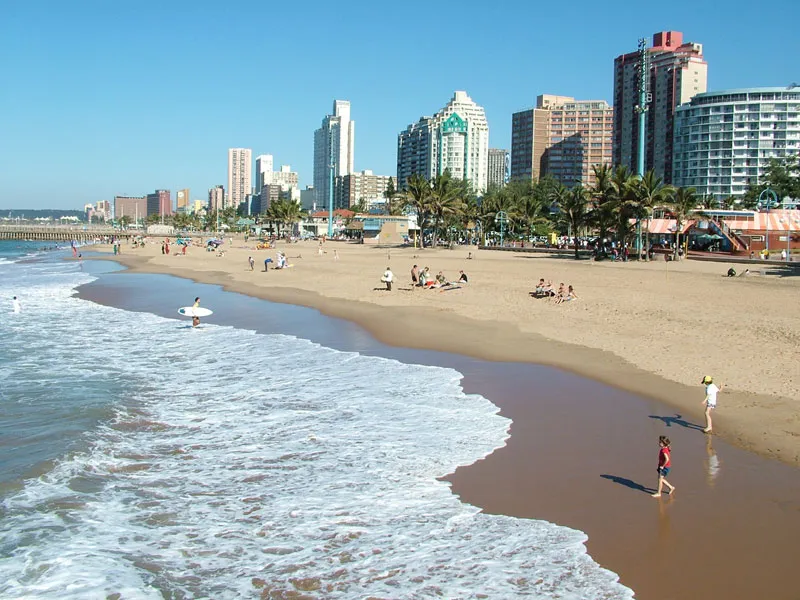
Durban’s beachfront stretches for six kilometers along what’s known as the Golden Mile, featuring wide sandy beaches, the promenade popular with joggers and cyclists, numerous hotels, and restaurants. The warm Agulhas Current ensures water temperatures averaging 21-25°C year-round, making swimming and surfing enjoyable even during winter months when Cape Town’s waters prove too cold for most.
North Beach and Dairy Beach attract surfers, while uShaka Beach offers calmer conditions suitable for families. The beachfront accommodates South Africa’s diverse population, with the vibrancy reflecting Durban’s cosmopolitan character.
Indian Cultural Influence
Durban hosts South Africa’s largest Indian population, descendants of indentured laborers brought to work sugarcane plantations during the British colonial era. This heritage permeates the city’s culture, particularly evident in cuisine, religious architecture, and commercial districts.
The Victoria Street Market offers sensory immersion in spices, fabrics, traditional medicines, and street food, with vendors selling bunny chow, samoosas, and various curries. The elaborate Hindu temples, including the Shri Ambalavaanar Alayam Temple, showcase Dravidian architectural styles rarely seen elsewhere in Africa.
uShaka Marine World
This integrated entertainment complex combines Africa’s largest aquarium, water park, restaurants, and shopping in a creatively designed space themed around a 1920s cargo ship. The aquarium’s walk-through tunnel provides close encounters with sharks, rays, and diverse marine species from the Indian Ocean and coral reefs, while the Ocean Walker experience allows certified divers to walk on the aquarium floor among the fish.
Wildlife Encounters: Safari Experiences
Kruger National Park: Africa’s Premier Wildlife Sanctuary
Spanning approximately 19,485 square kilometers—roughly the size of Israel or Wales—Kruger National Park represents one of Africa’s largest and most famous game reserves, protecting extraordinary biodiversity and offering visitors accessible yet authentic safari experiences.
The Big Five and Beyond
Kruger’s reputation rests substantially on Big Five sightings—lion, leopard, rhinoceros, elephant, and Cape buffalo—the animals historically considered most dangerous to hunt on foot and now the most sought-after photographic subjects.
The park hosts approximately 1,500 lions, organized in prides controlling defined territories, with dawn and dusk offering optimal viewing as these apex predators become active. Leopards, though more elusive due to solitary, nocturnal habits, number around 1,000, often observed resting in trees during daytime heat.
Kruger’s elephant population exceeds 17,000, with family herds led by matriarchs demonstrating complex social behaviors around waterholes and rivers. The park protects both black and white rhinoceros populations, though poaching pressures require intensive anti-poaching operations to ensure these critically endangered animals’ survival.
Buffalo herds, sometimes numbering hundreds of individuals, create dramatic scenes as they move across the savanna or gather at water sources.
Beyond the Big Five, Kruger hosts 147 mammal species including cheetahs, wild dogs, hyenas, giraffes, zebras, hippos, crocodiles, and numerous antelope varieties. The park’s 517 bird species attract ornithologists worldwide, while reptile enthusiasts appreciate over 110 species including various snakes, lizards, and tortoises.
Safari Options
Visitors can explore Kruger through multiple approaches:
Self-drive safaris offer independence and affordability, with well-maintained roads, clearly marked rest camps, and the flexibility to spend as much time as desired at interesting sightings. The park’s rest camps provide accommodation ranging from basic campsites to comfortable bungalows with cooking facilities.
Guided game drives, conducted in open safari vehicles by experienced rangers, significantly increase wildlife sighting probabilities through expert tracking skills, radio communication networks sharing animal location information, and off-road access unavailable to self-drivers. Rangers also provide ecological context, explaining animal behaviors, plant uses, and ecosystem dynamics.
Walking safaris, led by armed rangers, offer intimate bush experiences, focusing on smaller details—tracks, insects, plants—typically overlooked from vehicles, while creating thrilling awareness of sharing space with dangerous animals.
Luxury private concessions bordering Kruger provide exclusive safari experiences with higher guide-to-guest ratios, unrestricted game viewing including night drives, exceptional accommodation, gourmet cuisine, and amenities like swimming pools and spa treatments.
Best Visiting Seasons
Dry winter months (May through September) offer optimal game viewing as animals concentrate around limited water sources, vegetation thins allowing better visibility, and cooler temperatures increase animal activity during daylight hours. However, this period attracts peak tourist numbers and higher accommodation costs.
Summer months (November through March) bring lush landscapes, newborn animals, spectacular bird migrations, and fewer tourists, though afternoon thunderstorms and dense vegetation can complicate wildlife spotting.
Addo Elephant National Park: Pachiderms in Paradise
Located in the Eastern Cape near Port Elizabeth, Addo Elephant National Park was established in 1931 to protect the region’s last eleven elephants from extinction. Today, the park’s elephant population exceeds 600, providing virtually guaranteed sightings of these magnificent creatures.
The park’s relatively compact size (compared to Kruger) and high elephant density ensure excellent viewing opportunities, with family herds frequently observed at waterholes, particularly during midday heat. The park’s expansion now includes marine protected areas, making Addo the only park globally protecting Africa’s “Big Seven”—the Big Five plus southern right whales and great white sharks.
The malaria-free status makes Addo ideal for families with young children, while the temperate climate allows comfortable year-round visits.
Madikwe Game Reserve: Luxury Safari Without Malaria Risk
Situated along South Africa’s border with Botswana, Madikwe Game Reserve covers 75,000 hectares of pristine bushveld, successfully reintroduced wildlife, and operates as an exclusive safari destination with no day visitors permitted—only overnight guests at the private lodges.
The reserve’s malaria-free status, combined with excellent Big Five sightings, luxurious accommodations, and expert guiding, creates an ideal destination for travelers seeking premium safari experiences without health concerns.
Madikwe pioneered the “super pack” concept, introducing large wild dog populations that thrive in the reserve’s protected environment. These endangered predators, highly social and effective hunters, provide thrilling viewing opportunities unavailable in many other reserves.
Mountain Majesty: The Drakensberg Range
The Drakensberg (Afrikaans for “Dragon Mountains”), known as uKhahlamba (“Barrier of Spears”) in Zulu, forms a 200-kilometer mountain barrier along the border between South Africa and Lesotho, with peaks exceeding 3,000 meters creating dramatic basalt and sandstone landscapes.
Hiking Paradise
The Drakensberg offers South Africa’s premier hiking experiences, with trails ranging from gentle valley walks to challenging multi-day wilderness routes requiring mountaineering skills.
The Tugela Gorge hike leads to Tugela Falls, the world’s second-highest waterfall with a 948-meter drop, where water cascades down the sheer Amphitheatre cliff face. The approximately 14-kilometer return hike follows the Tugela River through indigenous forest and grasslands before ascending chain ladders to the amphitheater’s rim.
The Cathedral Peak area provides numerous day hikes through pristine valleys with crystal streams, San rock art sites, and dramatic mountain vistas. More experienced hikers attempt the technical climb to Cathedral Peak’s 3,004-meter summit.
Multi-day hikes like the Giant’s Cup Trail traverse 60 kilometers through remote wilderness, passing waterfalls, caves, and ancient San painting sites while camping in mountain huts.
Cultural Significance
The Drakensberg’s caves and rock overhangs contain over 600 rock art sites with approximately 35,000 individual paintings created by San (Bushmen) peoples over 4,000 years. These paintings, executed in natural pigments, depict eland and other animals, hunting scenes, shamanic rituals, and contact with Bantu and European peoples.
Main Caves, Battle Cave, and Game Pass Shelter offer accessible rock art viewing with interpretive information explaining the paintings’ spiritual and cultural significance.
The uKhahlamba-Drakensberg Park’s combined natural beauty and cultural heritage earned UNESCO World Heritage Status, recognizing both landscape significance and the rock art’s outstanding universal value.
Activities Beyond Hiking
The Drakensberg’s rivers and streams provide excellent trout fishing, with designated catch-and-release areas ensuring sustainable populations. The cool mountain climate attracts fly-fishing enthusiasts to pristine alpine environments.
Horse riding through mountain valleys offers alternative wildlife and landscape appreciation, while several locations offer abseiling, rock climbing, and mountain biking for adventure seekers.
Winter months transform the highest peaks with snowfall, creating rare African snow experiences and limited skiing opportunities.
Coastal Wonders and Scenic Routes
The Garden Route: South Africa’s Scenic Masterpiece
Stretching approximately 300 kilometers from Mossel Bay in the Western Cape to Storms River in the Eastern Cape, the Garden Route represents one of the world’s great scenic drives, traversing diverse ecosystems including indigenous forests, dramatic coastline, tranquil lagoons, and mountain ranges.
Knysna: Lagoon Living
The town of Knysna centers on a spectacular lagoon opening to the Indian Ocean through a narrow channel flanked by sandstone cliffs called the Knysna Heads. The lagoon’s sheltered waters support oyster farming, sailing, and various water sports.
The Knysna Forest, part of the larger Garden Route forest system, contains ancient yellowwood trees, diverse birdlife, and the legendary Knysna elephants—a tiny population descended from the herds that once roamed these forests extensively. While elephant sightings remain extremely rare, the forest’s hiking trails, fern-filled gorges, and birdsong create magical experiences.
The waterfront area features restaurants specializing in fresh oysters and seafood, craft markets, and art galleries showcasing local talent.
Plettenberg Bay: Beaches and Marine Life
Often shortened to “Plett,” this upscale resort town boasts spectacular beaches with warm Indian Ocean waters, making swimming, surfing, and beach activities enjoyable year-round.
The surrounding marine environment attracts dolphins, seals, and seasonal whale migrations, with boat-based whale watching and dolphin viewing excursions departing daily during peak seasons. Land-based whale watching from lookout points along the coastline provides free alternatives for patient observers.
The Robberg Nature Reserve, a dramatic peninsula extending into the ocean, offers a three-hour circular hike with spectacular coastal views, seal colonies, and possible whale sightings during migration seasons.
Tsitsikamma National Park: Where Forest Meets Ocean
This coastal park protects indigenous forest, dramatic coastline, and marine environments extending five kilometers offshore. The landscape features deep gorges carved by rivers flowing from the mountains to the sea through ancient forest.
The park’s iconic Storms River Mouth suspension bridge sways above the river gorge as waves crash against cliffs below, creating thrilling photo opportunities. The suspension bridge marks the start of the Otter Trail, South Africa’s most famous multi-day coastal hike, traversing 45 kilometers of pristine coastline, requiring five days and including river crossings where hikers must swim with backpacks.
The Tsitsikamma forest canopy tour provides adrenaline through a series of ziplines connecting platforms high in yellowwood trees, offering unique forest perspectives.
Hermanus: Whale Watching Capital
The coastal town of Hermanus, located 120 kilometers southeast of Cape Town, holds the distinction of offering the world’s best land-based whale watching, where southern right whales approach remarkably close to shore during their annual breeding migration.
Whale Season Spectacle
From July through November, southern right whales migrate from Antarctic feeding grounds to the warmer waters of Walker Bay to mate, calve, and nurse their young. The whales’ displays include breaching (launching entire bodies from the water), tail slapping, and spy-hopping (rising vertically to observe above water).
The cliff path extending several kilometers along the coastline provides numerous vantage points, with whales sometimes visible just meters from shore. Hermanus employs the world’s only “whale crier,” who patrols the town blowing a kelp horn to announce whale sightings and their locations.
Boat-based whale watching offers closer encounters while maintaining respectful distances required by conservation regulations. These excursions sometimes encounter dolphins, seals, and seabirds alongside the whales.
Beyond Whale Season
Outside whale season, Hermanus offers wine estates in the nearby Hemel-en-Aarde Valley producing excellent cool-climate wines, particularly Pinot Noir and Chardonnay. The coastal walks, craft markets, restaurants, and art galleries maintain appeal year-round.
Nearby Gansbaai offers cage diving with great white sharks, providing adrenaline seekers with thrilling underwater encounters with these apex predators in their natural environment.
Cape Point: Where Oceans Converge
The Cape Point section of Table Mountain National Park extends to the rocky promontory forming the southwestern tip of Africa, where the Atlantic and Indian Oceans’ waters intermingle in dramatic displays of natural power.
Dramatic Landscapes
The coastline features towering cliffs dropping precipitously to churning seas below, with walking trails providing access to viewpoints overlooking the ocean expanse. The area’s biodiversity includes fynbos vegetation, baboon troops, various antelope species, and remarkable birdlife including Cape cormorants and the endangered black oystercatcher.
The historic lighthouse, originally built in 1859 but frequently obscured by mist, was replaced by a lower lighthouse in 1919. The funicular railway transports visitors to the old lighthouse viewpoint, though many prefer the walking path’s closer engagement with the landscape.
The Cape of Good Hope, often confused with Cape Point but actually a separate promontory approximately two kilometers to the southwest, features a popular photo stop at the signboard indicating the location.
Boulders Beach Penguins
En route to Cape Point, Boulders Beach near Simon’s Town provides unique opportunities to observe African penguins in their natural habitat. This endangered species established a breeding colony here in 1982, growing to over 3,000 birds.
Boardwalks allow close viewing without disturbing the birds, which waddle comically across the sand, nest in vegetation, and swim in the sheltered waters. The beach permits swimming in designated areas, creating surreal experiences sharing the ocean with penguins.
Chapman’s Peak Drive: Coastal Engineering Marvel
This nine-kilometer coastal road carved into the mountainside between Hout Bay and Noordhoek ranks among the world’s most spectacular drives, hugging cliffs 600 meters above the ocean with 114 curves offering constantly changing seascapes.
Constructed between 1915 and 1922, largely by hand, the road demonstrates remarkable engineering, with modern stabilization work ensuring safety while preserving the dramatic route. Numerous viewpoints provide opportunities to stop, photograph, and simply absorb the ocean vistas.
Cyclists challenge themselves on the route’s gradients, while motorcyclists savor the curves and scenery. The toll road charges a modest fee contributing to ongoing maintenance.
Wine Country Elegance: The Cape Winelands
Stellenbosch: Where Tradition Meets Innovation
South Africa’s second-oldest town, established in 1679, Stellenbosch combines historical architecture, vibrant university culture, and world-renowned wine production. The town’s oak-lined streets, Cape Dutch buildings, and sidewalk cafés create European ambiance in African settings.
Wine Excellence
The Stellenbosch Wine Route, established in 1971 as South Africa’s first, now encompasses over 150 wine estates producing internationally acclaimed wines, particularly Cabernet Sauvignon, Pinotage (South Africa’s signature red varietal), and Chenin Blanc.
Estates like Delaire Graff combine wine tasting with fine dining, contemporary art collections, and luxury accommodation, positioning wine experiences within broader luxury lifestyle contexts. Smaller boutique wineries offer intimate tastings where winemakers personally discuss their craft and terroir.
The region’s wine tourism infrastructure accommodates all budgets, from affordable tastings at cooperative cellars to exclusive private tours and picnics in vineyard settings.
Culinary Scene
Stellenbosch’s concentration of award-winning restaurants reflects South Africa’s gastronomic renaissance, with chefs creating innovative cuisine showcasing local ingredients, particularly when paired with estate-produced wines.
The town’s central Dorp Street and surrounding areas host diverse dining options, from traditional South African fare to contemporary fusion, Italian trattorias, and Asian-influenced establishments. Weekly farmers’ markets provide fresh produce, artisanal products, and street food.
Franschhoek: The Gourmet Capital
This picturesque valley town, founded by French Huguenot refugees in the late 17th century, maintains French cultural influences visible in street names, architecture, and particularly the emphasis on culinary excellence that earned Franschhoek its reputation as South Africa’s gourmet capital.
World-Class Restaurants
Franschhoek’s concentration of fine dining establishments, relative to its small size, is remarkable. Several restaurants consistently feature among Africa’s best, offering sophisticated cuisine, extensive wine lists, and elegant settings with mountain views.
The annual Franschhoek Uncorked festival and Bastille Day celebrations showcase the valley’s gastronomic culture through wine and food pairings, culinary demonstrations, and festive atmosphere.
Wine Tram
The Franschhoek Wine Tram offers a unique touring method, combining vintage tram rides with hop-on-hop-off access to wine estates. The open-air trams traverse the valley, stopping at various estates where visitors disembark for tastings before continuing the journey.
This approach eliminates drinking-and-driving concerns while providing leisurely appreciation of the valley’s scenery and wines.
Paarl: Mountain Majesty and Wine Heritage
The town of Paarl, named after the granite domes of Paarl Mountain that glisten like pearls after rain, offers wine experiences alongside historical significance as the birthplace of Afrikaans language formalization.
Large-scale estates like Nederburg and KWV produce wines for international markets, offering comprehensive cellar tours explaining production processes from grape to bottle. Smaller family wineries provide intimate experiences highlighting generational winemaking traditions.
The Afrikaans Language Monument on Paarl Mountain commemorates Afrikaans’ development as a distinct language, with the monument’s design representing the language’s diverse linguistic influences.
Unique Experiences and Hidden Gems
Cradle of Humankind: Journey to Human Origins
Located approximately 50 kilometers northwest of Johannesburg, the Cradle of Humankind UNESCO World Heritage Site encompasses a complex of limestone caves containing the world’s richest hominin fossil sites, providing crucial evidence for understanding human evolution.
Sterkfontein Caves
This extensive cave system yielded numerous significant fossil discoveries, including “Mrs. Ples,” a 2.05-million-year-old Australopithecus africanus skull found in 1947, and “Little Foot,” a remarkably complete Australopithecus skeleton approximately 3.67 million years old—among the most complete early hominin skeletons ever discovered.
Guided tours descend into the caves, exploring underground lakes and chambers while learning about fossil discoveries, cave geology, and early human evolution. The Maropeng Visitor Centre provides interactive exhibits explaining human origins, evolution science, and fossil significance through multimedia displays engaging visitors of all ages.
Significance for Understanding Humanity
The Cradle’s fossil record spans millions of years, documenting evolutionary transitions from early ape-like ancestors to modern humans. The discoveries contribute fundamentally to anthropology, paleontology, and our understanding of what makes us human.
The site’s accessibility from Johannesburg makes this profound connection to human origins remarkably convenient for travelers.
Namaqualand: Nature’s Flower Carpet
The arid region of Namaqualand in South Africa’s Northern Cape undergoes a spectacular transformation each spring (August-September) when, following winter rains, the desert landscape explodes into vibrant wildflower displays covering thousands of square kilometers.
Annual Flower Spectacle
Over 4,000 plant species, many endemic to the region, bloom simultaneously, creating carpets of orange, white, yellow, and purple flowers stretching to the horizon. The exact timing and intensity depend on rainfall patterns, with good rain years producing extraordinary displays attracting photographers and nature enthusiasts worldwide.
The flowers demonstrate remarkable adaptation, with many species existing as seeds underground for years, sprouting only when conditions perfectly suit their survival. The blooms open in response to sunlight, creating the peculiar phenomenon of flowers “following” the sun throughout the day.
Experiencing the Flowers
The towns of Springbok, Kamieskroon, and Niewoudtville serve as bases for exploring the region. Self-drive routes wind through the landscape, with regular stops to walk among the flowers and photograph the displays.
The Namaqua National Park protects significant portions of the flower region, with designated viewing areas and walking trails. Park rangers provide information about flowering conditions and optimal viewing locations based on current bloom status.
Blyde River Canyon: Green Canyon Majesty
The Blyde River Canyon in Mpumalanga ranks among the world’s largest green canyons, with lush subtropical vegetation covering the canyon walls in striking contrast to the typical barren landscapes of most major canyons.
Panoramic Viewpoints
The canyon’s most famous viewpoint, God’s Window, offers vertiginous views plunging approximately 900 meters to the lowveld below, with visibility extending to Kruger National Park on clear days. The subtropical forest at the viewpoint provides pleasant walking trails through indigenous vegetation.
The Three Rondavels viewpoint provides the canyon’s iconic vista, where three massive cylindrical rock formations rise from the canyon floor, resembling traditional African dwelling structures. The Blyde River curves between the formations, creating dramatic compositions beloved by photographers.
Bourke’s Luck Potholes, formed over millions of years by water erosion creating cylindrical holes in the rock, offer geological fascination and unique photographic opportunities. Walkways and bridges allow close examination of these natural sculptures carved by the river’s relentless force.
Activities
The canyon area provides diverse activities including hiking trails ranging from short walks to multi-day adventures, boat trips on the Blyde Dam offering water-level canyon perspectives, and scenic drives along the Panorama Route connecting viewpoints.
The region’s elevation creates pleasant temperatures year-round, with the green vegetation providing beauty even during dry winter months when other regions appear brown and dormant.
Bloukrans Bridge: Adrenaline at 216 Meters
Located on the Garden Route between Plettenberg Bay and Storms River, Bloukrans Bridge hosts the world’s highest commercial bungee jump from a bridge, with jumpers leaping 216 meters above the Bloukrans River gorge.
The Ultimate Leap
After being harnessed and briefed, jumpers walk to the jumping platform suspended beneath the bridge’s road deck. The countdown and leap create intense adrenaline surges as jumpers freefall before the bungee cord arrests the plunge, followed by several bounces before being lowered to the gorge floor for extraction.
For those not ready to jump, the bridge walk allows pedestrians to cross the bridge’s length on a catwalk, experiencing impressive heights and views without the commitment of jumping.
Safety and Professionalism
Face Adrenalin, the operating company, maintains stringent safety standards, with equipment regularly inspected and replaced, experienced jump masters overseeing all jumps, and comprehensive briefings ensuring jumpers understand the experience.
The operation has facilitated over 300,000 jumps since inception, with an excellent safety record providing reassurance to nervous first-time jumpers.
Practical Travel Information
Best Times to Visit
South Africa’s diverse geography creates varied optimal visiting periods by region and purpose:
Wildlife Viewing: May through September offers dry conditions concentrating animals around water sources, though Kruger remains worthwhile year-round.
Cape Town and Western Cape: November through March provides warm, dry summer weather ideal for beaches and outdoor activities, though this peak season brings crowds and higher costs. April-May and September-October offer pleasant conditions with fewer tourists.
Whale Watching: July through November for southern right whales in Hermanus and along the Western Cape coast.
Flower Season: August-September in Namaqualand, dependent on rainfall.
Garden Route: Year-round destination, though summer (December-February) offers warmest ocean temperatures.
Entry Requirements and Visas
Many nationalities, including USA, UK, EU countries, Australia, and many others, receive automatic 90-day tourist visas upon arrival. Passports must have at least two blank pages and validity extending at least 30 days beyond intended departure.
Travelers should verify current requirements well in advance, as regulations change periodically.
Health Considerations
Malaria: Present in Kruger National Park and other lowveld areas, requiring prophylaxis during visits. Consult travel health professionals about appropriate medication. Addo, Madikwe, and many other reserves are malaria-free.
Vaccinations: No mandatory vaccinations for most travelers, though hepatitis A, typhoid, and routine vaccinations are recommended. Yellow fever vaccination required only for travelers arriving from yellow fever endemic countries.
Water: Tap water in major cities is safe to drink, though bottled water is readily available.
Altitude: Some areas, particularly Johannesburg (1,753 meters) and the Drakensberg, sit at elevations requiring brief acclimatization for some visitors.
Safety Considerations
While South Africa offers extraordinary experiences, visitors should maintain reasonable security awareness:
Urban Areas: Avoid displaying expensive jewelry, cameras, or phones conspicuously. Use hotel safes for valuables. Stick to well-populated, well-lit areas after dark. Avoid walking alone at night in cities. Use registered taxis or rideshare services rather than street hailing.
Vehicle Safety: Keep doors locked and windows up when driving in cities. Don’t leave visible valuables in parked cars. Be cautious at traffic lights in certain areas. Use secure parking when available.
Wildlife: Maintain safe distances from all wild animals. Never exit your vehicle in unfenced areas. Follow all park regulations and ranger instructions.
Townships: Visit only with reputable tour operators or local guides who understand the areas and provide cultural context appropriately.
Most visitors experience trouble-free trips by exercising common sense and heeding local advice.
Getting Around
Domestic Flights: Airlines including South African Airways, FlySafair, Kulula, and others connect major cities efficiently, with Cape Town-Johannesburg being one of the world’s busiest routes.
Car Rental: Self-driving offers maximum flexibility, with well-maintained roads and clear signage. South Africans drive on the left. International driving permits may be required depending on nationality.
Organized Tours: Numerous companies offer everything from day trips to multi-week itineraries, eliminating logistics stress.
Baz Bus: A hop-on-hop-off bus service connects backpacker hostels along routes between major destinations, popular with budget travelers and those preferring not to drive.
Budget Considerations
South Africa accommodates all budget levels:
Budget: Backpacker hostels, camping, self-catering, and local restaurants allow daily costs of $30-50 USD per person.
Mid-Range: Three-star hotels or guesthouses, restaurant meals, organized day tours, and car rental typically cost $100-200 USD daily per person.
Luxury: Five-star hotels, luxury safari lodges, fine dining, and private guides can exceed $500-1000+ USD daily per person.
The favorable exchange rate for USD, EUR, and GBP provides excellent value compared to many other destinations of comparable quality.
Conclusion: A Destination for Every Traveler
South Africa’s extraordinary diversity ensures fulfilling experiences regardless of interests, budgets, or travel styles. From the cosmopolitan sophistication of Cape Town to the raw wilderness of Kruger, the cultural richness of Soweto to the tranquil beauty of the Winelands, the adventure of Bloukrans to the reflection of the Apartheid Museum, the country delivers experiences that educate, inspire, challenge, and delight.
The infrastructure supporting tourism—excellent accommodations across all price ranges, well-maintained roads, English-speaking population, and world-class attractions—makes South Africa among Africa’s most accessible destinations while maintaining authentic African character and wildlife experiences rivaling anywhere on the continent.
Whether seeking wildlife photography, cultural immersion, culinary indulgence, adventure sports, historical understanding, or simply relaxation amid spectacular scenery, South Africa rewards travelers with memories lasting lifetimes and often inspires return visits to explore the depth and diversity impossible to exhaust in a single journey.
The Rainbow Nation’s transformation from apartheid’s dark legacy to an vibrant, democratic, multicultural society adds profound dimensions to any visit, providing opportunities to witness a nation actively building its future while honoring complex histories.
For those considering their next travel destination, South Africa presents compelling arguments: unmatched wildlife, spectacular landscapes, rich culture, excellent infrastructure, favorable exchange rates, and the intangible magic that makes this corner of Africa truly special.
Begin planning your South African adventure today—the Mother City’s mountain, the bush’s call, and the Rainbow Nation’s warm welcome await.
Essential Quick Reference:
Capital Cities: Pretoria (administrative), Cape Town (legislative), Bloemfontein (judicial)
Currency: South African Rand (ZAR)
Languages: 11 official languages; English widely spoken
Best Overall Time: September-November (spring) or March-May (autumn)
Must-See Highlights: Cape Town, Kruger National Park, Garden Route, Cape Winelands, Johannesburg
Average Trip Duration: 10-14 days for comprehensive introduction; 7 days minimum
International Airports: Cape Town (CPT), Johannesburg (JNB), Durban (DUR)
Driving: Left-hand side
Tipping: 10-15% in restaurants; small amounts for services
Emergency Number: 10111 (police), 10177 (ambulance)
Related Searches: South Africa safari packages, Cape Town travel guide 2026, Garden Route itinerary, Kruger Park accommodation, Stellenbosch wine tours, best time visit South Africa, South Africa vacation cost, Cape Winelands hotels, Hermanus whale season, Drakensberg hiking trails, South Africa travel safety, Johannesburg to Cape Town, African safari tips, Namaqualand flowers 2026, Table Mountain cable car
